
New Progress in Green and Scalable Production of Graphene from ECUST Published in Advanced Functional Materials
Recently, a research team led by Research Associate Professor Liangzhu Zhang from the School of Materials Science and Engineering, ECUST, developed a green and efficient strategy for the scalable production of high-quality graphene nanosheets through solid lithiation and exfoliation. The findings were published in Advanced Functional Materials under the title “Green and Scalable Production of High-Quality Graphene by Solid Lithiation and Exfoliation.”
Graphene possesses a perfect two-dimensional crystal structure composed of sp²-hybridized carbon atoms. Its exceptional electrical, thermal, and mechanical properties are closely associated with its structural quality. The conventional Hummer’s method relies on strong acids and oxidants, resulting in environmental concerns and defects in the resulting graphene. Therefore, developing an environmentally friendly and efficient approach for producing high-quality graphene remains highly desirable.
In this work, the researchers successfully prepared high-quality few-layer graphene under environmentally benign conditions using solid lithiation and exfoliation, achieving a yield of up to 26.7%. The resulting graphene exhibited excellent crystallinity and outstanding structural integrity. High-resolution transmission electron microscopy (HRTEM) and atomic force microscopy (AFM) analyses confirmed a uniform few-layer structure with an average thickness of approximately 1.1 nm.
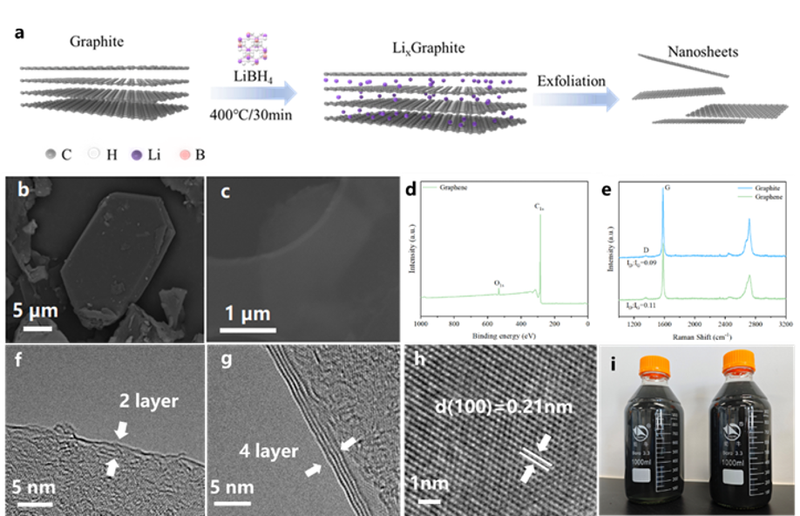
Raman spectroscopy revealed an extremely low ID/IG ratio of approximately 0.11 together with a sharp 2D band, providing direct evidence of the graphene’s low defect density and high quality. X-ray photoelectron spectroscopy (XPS) further demonstrated the low degree of oxidation of the prepared graphene, with a carbon-to-oxygen (C/O) ratio as high as 24.6.
Together, these systematic characterizations demonstrated that solid lithiation and exfoliation effectively overcame key limitations of conventional graphene production processes, including environmental pollution, low yield, and high defect density, while offering strong potential for scalable manufacturing.
Guoqiang Li, a master’s student from the School of Materials Science and Engineering, ECUST, is the first author of the paper. Liangzhu Zhang, a Research Associate Professor from ECUST, and Zhongshuai Wu, a Research Professor from the Dalian Institute of Chemical Physics, Chinese Academy of Sciences, are the corresponding authors. This work was supported by the National Natural Science Foundation of China, Shanghai Leading Talent Program of Eastern Talent Plan, and the Open Topic Fund of the State Key Laboratory.