
New Progress in Photothermal Dry Reforming of Methane from ECUST Published in JACS
Recently, the research team led by Professor Jinlong Zhang from the School of Chemistry and Molecular Engineering at ECUST has made new progress in photothermal dry reforming of methane. The results, titled “Interfacial Oxide Engineering of TiN Antenna-Reactor for Durable Photothermal Dry Reforming of Methane,” were published in the Journal of the American Chemical Society.
Dry reforming of methane (DRM) converts two major greenhouse gases, CH₄ and CO₂, into syngas, serving as a versatile pathway for the high-value utilization of carbon resources. However, traditional reactions typically require high temperatures, which readily induce nanoparticle sintering and carbon deposition. Solar-driven photothermal catalysis is expected to reduce energy consumption and improve reaction efficiency through photoexcited carriers and localized photothermal heating.
Titanium nitride (TiN) combines broadband absorption with pronounced localized surface plasmon resonance, making it an ideal material for constructing photothermal catalytic systems. Nevertheless, in reaction environments involving strong light, high temperatures, and CO₂, TiN is prone to oxidative reconstruction, which undermines active metal stability and reaction selectivity. How to maintain the photothermal advantages of TiN while enhancing the long-term stability of the catalyst remains a critical challenge in this field.
To address these issues, the team proposed a surface-oxide engineering strategy, in situ constructing a crystalline TiO₂ shell on the TiN surface and loading highly dispersed Ru nanoclusters to form a TiN@TiO₂-Ru core-shell antenna-reactor architecture (Figure a). In this architecture, the TiN core is responsible for light absorption and photothermal conversion, while the TiO₂ interlayer stabilizes TiN, anchors Ru clusters, and regulates interfacial charge and heat transfer. Under concentrated illumination without external heating, the catalyst exhibits excellent photothermal DRM performance. The formation rates of CO and H₂ reach 1.28 and 0.82 mol g⁻¹ h⁻¹, respectively, and it retains over 98% of its initial syngas productivity after 80 hours of continuous reaction.
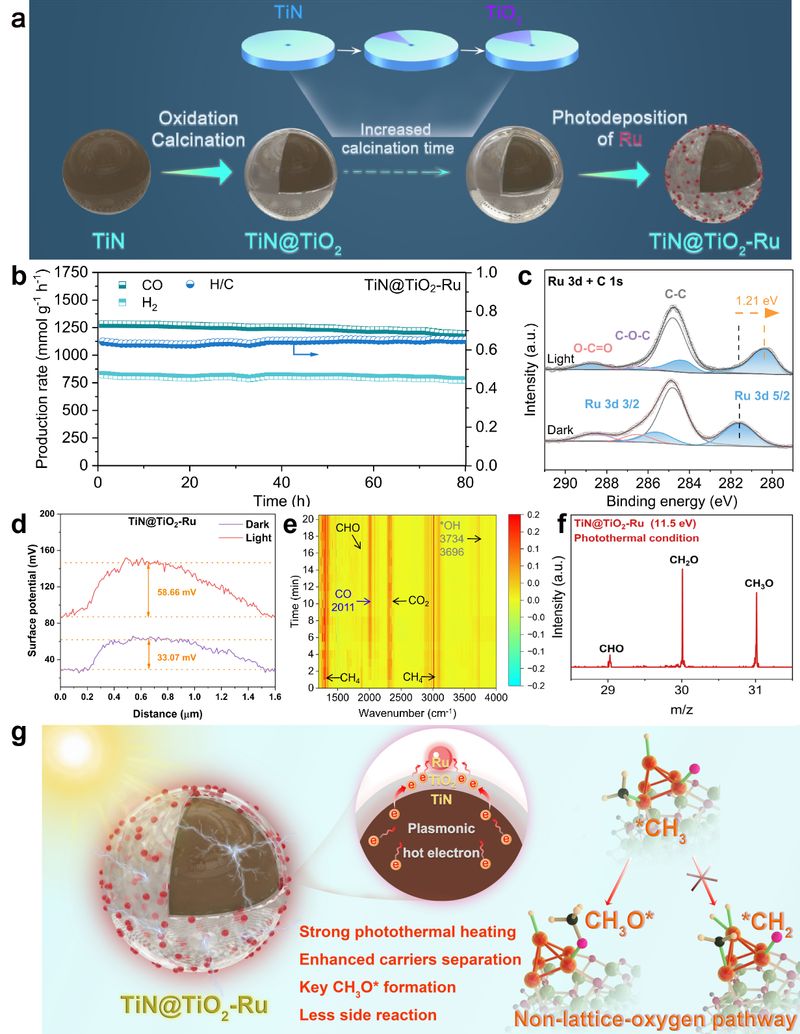
In situ characterizations and isotope-labeling experiments indicate that the TiO₂ interlayer promotes directional charge transfer among TiN, TiO₂, and Ru, enhances the cooperative activation of CH₄ and CO₂ at Ru sites, and drives the reaction primarily through a non-lattice oxygen pathway involving CO₂-derived oxygen species, thereby effectively suppressing side reactions and carbon deposition (Figures c through g).
This study reveals the critical role of the TiO₂ interlayer in resisting oxidative reconstruction, stabilizing metal clusters, and regulating light-driven reaction pathways, providing new insights for the design of efficient and stable photothermal DRM catalysts and offering a reference for the solar-driven resource utilization of greenhouse gases.
ECUST is the sole corresponding institution for this paper. PhD candidate Qixin Li is the first author. Professor Jinlong Zhang and research associate professor Shiqun Wu are the co-corresponding authors. This research was supported by the National Key Research and Development Program of China, the National Natural Science Foundation of China, the Innovation Program of the Shanghai Municipal Education Commission, the Science and Technology Commission of Shanghai Municipality, and the Chenguang Program of the Shanghai Education Development Foundation and Shanghai Municipal Education Commission.