
New Progress in Enzyme-Constrained Metabolic Modeling and Proteome Abundance Prediction from ECUST Published in Nature Communications
Recently, Associate Professor Guan Wang from the School of Biotechnology at ECUST and Associate Professor Hongzhong Lu from Shanghai Jiao Tong University have made progress in the field of enzyme-constrained metabolic modeling and proteome abundance prediction. Their research, titled “EnzymeTuning improves enzyme-constrained metabolic modeling and proteome abundance prediction through deep learning,” was published in Nature Communications.
Enzyme-constrained genome-scale metabolic models (ecGEMs) are important research tools in metabolic engineering and synthetic biology. They can be used to predict cellular metabolic behavior, elucidate resource allocation mechanisms, and guide the rational design of industrial cell factories. However, the predictive performance of these models relies heavily on the accuracy of enzyme kinetic parameters, particularly enzyme turnover numbers (kcat). Existing parameter datasets often suffer from limited coverage, substantial differences in experimental conditions, and an inability to accurately reflect the complex intracellular catalytic environment, significantly restricting model accuracy and broader applications.
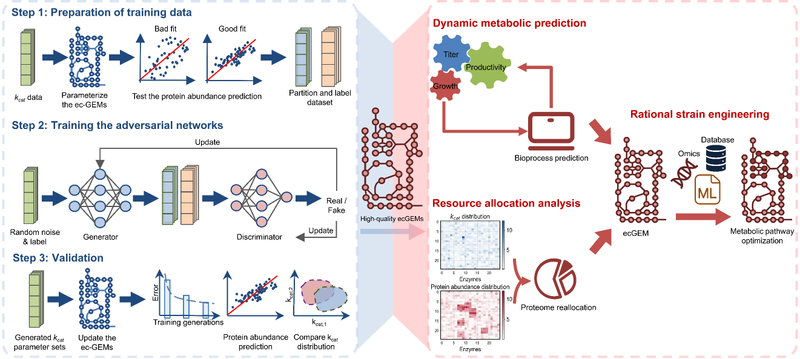
To address these challenges, the research team developed EnzymeTuning, a deep-learning framework based on a generative adversarial network (GAN), enabling the global optimization of enzyme kinetic parameters in enzyme-constrained metabolic models. Under growth phenotype constraints, the framework systematically improved the prediction accuracy of proteome abundance while substantially reducing prediction errors for extreme enzymes.
Furthermore, the researchers incorporated literature-derived protein degradation constants (kdeg) to infer protein synthesis rates (vsyn) and integrated them into the model constraint system, thereby effectively expanding the coverage of predictable proteins.
The results demonstrated that EnzymeTuning not only achieved excellent performance in Saccharomyces cerevisiae, but was also successfully extended to several important industrial microorganisms, including Kluyveromyces lactis, Kluyveromyces marxianus, Yarrowia lipolytica, and Escherichia coli, highlighting its strong generalizability and scalability.
In addition, the framework can be used to analyze cellular enzyme utilization patterns and catalytic resource allocation principles under different nutrient conditions, while also facilitating the identification of potential metabolic engineering targets. The study provided a new computational tool for the rational design of high-performance industrial microbial strains and offers valuable theoretical and methodological support for synthetic biology research.
The first author of the paper is Xueting Wang, a PhD candidate from the School of Biotechnology at ECUST. Associate Professor Guan Wang and Associate Professor Hongzhong Lu serve as co-corresponding authors. The work was conducted under the guidance of Professor Yingping Zhuang.
This research was supported by the National Key R&D Program of China, the National Natural Science Foundation of China, the Explorers Program of Shanghai (Basic Research Funding), the Natural Science Foundation of Shanghai, and the Jiangsu Provincial Major Science and Technology Special Project.