
New Progress in Polymer Nanoassembly Regulation and Immunotherapy from ECUST Published in Advanced Functional Materials
Recently, the research team led by Professor YiSheng Xu from ECUST, in collaboration with Professor Tao Xie from Zhongshan Hospital, has made progress in the regulation of polymer nanoassembly and its application in immunotherapy. The findings were published in Advanced Functional Materials (Adv. Funct. Mater., 2026, 36, e74718) under the title “A ‘Depolarization-Activation’ Strategy Targeting Microglia: Cuproptosis-Mediated Immune Re-Sensitization Nanoplatform in Glioma Therapy”.
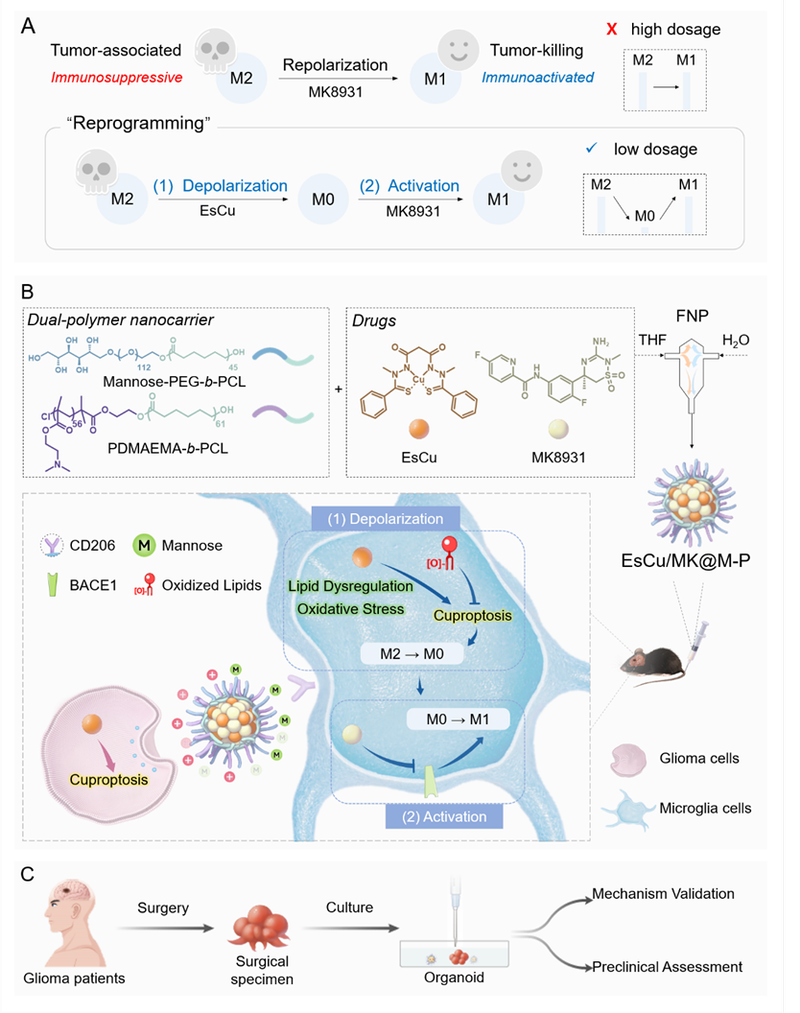
Precise structural control of polymer nanoassemblies is critical for synergistic drug delivery and targeted cancer therapy. However, directly inducing tumor-associated microglia/macrophages (TAMs) to polarize toward an anti-tumor phenotype within the immunosuppressive glioma microenvironment remains challenging, largely due to tumor heterogeneity and concerns regarding dose-related toxicity.
To address this challenge, the team designed a nanoplatform (EsCu/MK@M-P) via co-assembly of PDMAEMA-b-PCL block copolymers with mannose-modified mPEG-b-PCL. By employing flash nanoprecipitation to precisely control nucleation and growth, the platform achieved efficient co-loading of the cuproptosis inducer EsCu and the immune activator MK8931.
Furthermore, polymer architecture was engineered to exhibit pH-responsive behavior, while mannose modification enabled selective delivery to TAMs via their highly expressed CD206 receptors. Based on this dual-targeting design, EsCu/MK@M-P first depolarized TAMs through sub-lethal induction of cuproptosis, then redirected these cells toward the anti-tumor M1 phenotype using MK8931 at a dose far below the conventional regimen, thereby enabling potent immune-mediated killing of tumor cells. In addition, glioma organoid models established from surgical specimens of patients with different glioma subtypes were employed to validate the broad-spectrum antitumor efficacy and favorable biosafety of this strategy.
The corresponding authors are Professor YiSheng Xu, Professor Tao Xie, and postdoctoral researcher Yue Wu. The first authors are Yi Liu, a master’s degree candidate from Fudan University, and Yue Wu. This work was conducted under the guidance of Academician Weihong Zhu and supported by the National Natural Science Foundation of China and the Science and Technology Commission of Shanghai Municipality, among others.