
New Progress in Dynamic Charge-Dependent Polymeric Nanopesticide Delivery System from ECUST Published in Chem
Recently, a research team led by Academician Weihong Zhu from the School of Chemistry and Molecular Engineering and Professor Yisheng Xu from the School of Chemical Engineering at ECUST has made new progress in the study of precise deposition and efficient delivery of polymer-based nanopesticides. The findings, titled “A dynamic charge-dependent nanofungicide platform for sustainable agrochemical deposition and delivery,” were published in Chem.
Sprayed agrochemical application is an essential approach for safeguarding food production. However, during conventional spraying processes, active ingredients are often lost through photolysis, foliar runoff, and limited uptake, resulting in low utilization efficiency. Among these factors, weak foliar adhesion and the resulting non-target loss are major constraints. In recent years, polymeric nanocarriers have emerged as an effective strategy for improving agrochemical deposition and delivery efficiency because of their structural tunability and controllable interfacial properties.
Since plant cuticles are typically negatively charged, positively charged polymer interfaces can enhance foliar deposition and retention through electrostatic interactions. However, excessively strong positive charges may lead to overly strong surface binding, thereby restricting the permeation and subsequent uptake of active ingredients, creating a dilemma that makes it difficult to balance “high deposition” and “high uptake”.
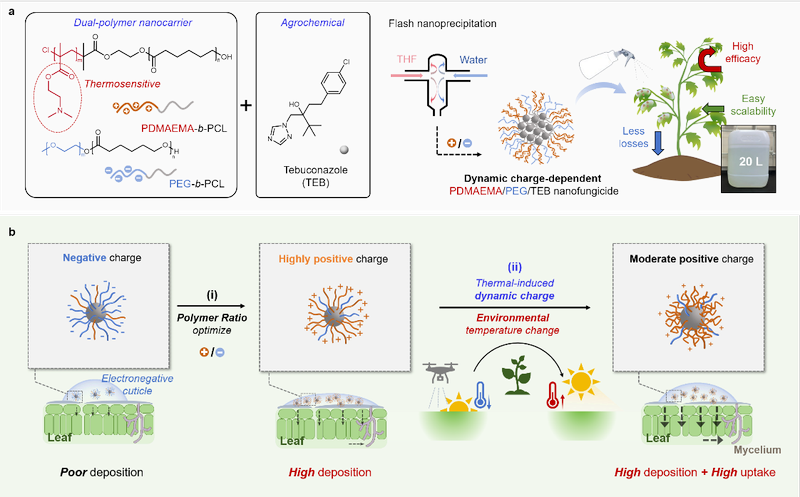
To address the aforementioned issues, the research team proposed a thermo-responsive polymer structural regulation strategy. By assembling polymers with oppositely charged components, they developed a “dynamic” surface-charge-featured nanofungicide platform. In this system, the incorporated thermo-responsive polymer unit can induce an in situ transition of surface charge from an initially high positive state to a moderate positive state triggered by environmental temperature. The former promoted rapid foliar deposition and strong retention on negatively charged leaves after spraying, while the latter mitigated excessive interfacial binding and facilitated the subsequent uptake and delivery of the broad-spectrum fungicide tebuconazole (TEB). This nanofungicide achieved a curative effect of 98% against Botrytis cinerea (B. cinerea) under half the standard dosage, significantly improving pesticide utilization efficiency.
Further scale-up preparation, field trials, and toxicity assessments demonstrated that this polymeric nanoplatform possessed good potential for process scale-up and practical application. The research revealed the intrinsic relationship among thermo-responsive polymer structures, interfacial charge properties, and agrochemical deposition and uptake behavior, providing a novel solution for developing efficient and sustainable nanopesticide delivery systems under climate change conditions.
This work was completed by postdoctoral researcher Miaojie Yu, PhD candidate Jia Wang, and postdoctoral researcher Yue Wu, under the guidance of Academician Weihong Zhu and Professor Yisheng Xu. The research was supported by the National Natural Science Foundation of China and the Shanghai Scientific Research and Innovation Program.