
New Progress in Metal-Organic Nanocluster Photoresists from ECUST Published in Science China Chemistry and Advanced Functional Materials
Recently, Professor Yisheng Xu’s research group from the School of Chemical Engineering, ECUST, has achieved a series of breakthroughs in the design of metal-organic nanocluster photoresists and their applications in micro/nano fabrication. The relevant research findings were published in Science China Chemistry and Advanced Functional Materials, respectively.
Micro/nano lithography acts as a core technology for integrated circuit manufacturing, micro/nano device processing and advanced manufacturing. As device sizes shrink continuously to the nanoscale, traditional organic photoresists face challenges in resolution, sensitivity and structural stability. Metal-Organic Nanoclusters (MOCs) combine the excellent radiation absorption capacity of inorganic components and the designability of organic ligands, making them promising candidates for next-generation high-performance photoresist materials.
Nevertheless, there is a lack of systematic understanding of how ligand structures affect lithographic sensitivity and the corresponding photochemical reaction mechanisms. Meanwhile, in the field of three-dimensional micro/nano printing based on Two-Photon Polymerization (TPP), traditional photoinitiators remain permanently embedded in polymer networks. This defect impairs the mechanical properties of microstructures and limits the application of such materials in high-performance microdevices.
To tackle the above challenges, the research team conducted studies on regulating the functions of nanoclusters via ligand engineering and established a novel material design strategy covering nanolithography and three-dimensional micro/nano fabrication.
In the research on photoresists, the team designed and synthesized a series of zirconium-based metal-organic nanocluster photoresists substituted with groups of different electronic effects. By introducing substituents such as methyl, fluorine and iodine, the group systematically explored how the electronic structures of organic ligands influenced lithographic sensitivity.
The results revealed that methyl-substituted ligands with electron-donating characteristics greatly improved the exposure sensitivity of nanocluster photoresists. Among all samples, the methyl-modified Zr-mMeBA nanocluster delivered the optimal lithographic performance. It realized excellent patterning effects under deep ultraviolet and electron beam exposure, and successfully fabricated patterns with a line width of 32 nm. Combined with density functional theory calculations, the team clarified the internal mechanism that the electron-donating effect of ligands regulated the stability and electronic structures of nanoclusters and further changed the activity of exposure reactions. This work provided a new theoretical basis for the rational design of high-performance metal-organic photoresists.
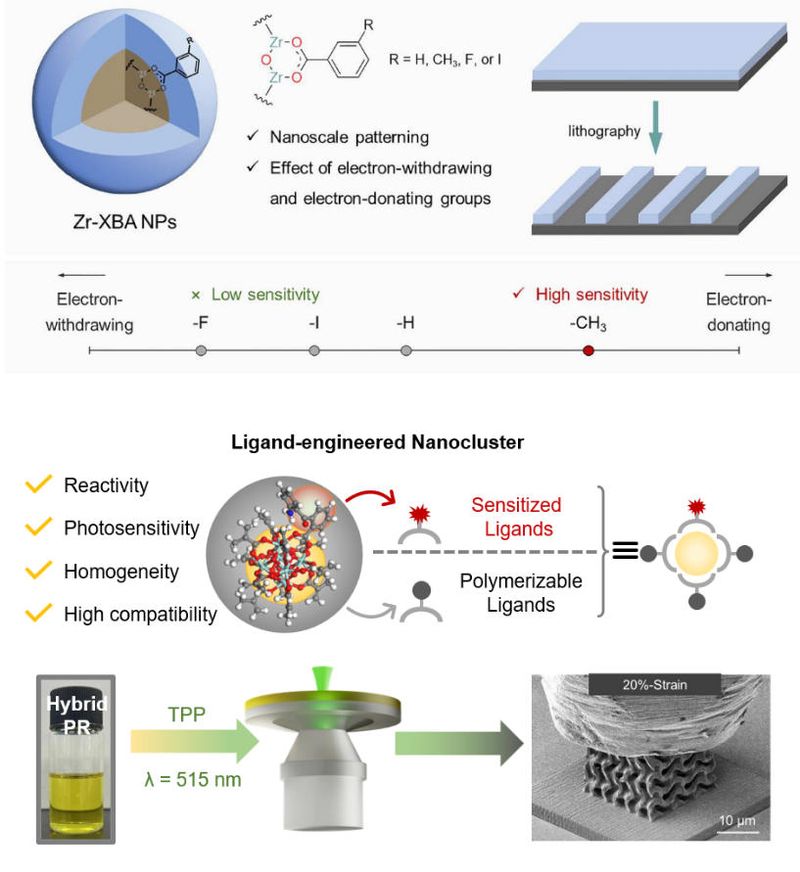
In the research of Two-Photon Polymerization-based micro/nano fabrication, the team further put forward the design concept of “ligand-engineered nanoclusters”. Adopting the ligand exchange strategy, researchers co-introduced photosensitive ligands and polymerizable ligands onto the surface of zirconium-based nanoclusters, and developed a new type of ligand-engineered nanoclusters that serve simultaneously as photoinitiators in the TPP resist and as mechanical reinforcement after polymerization. The results showed that the prepared nanoclusters served as efficient photoinitiators during Two-Photon Polymerization and embedded firmly into polymer networks as nano-reinforcement phases after polymerization.
The material exhibited a two-photon absorption cross-section of 22.45 GM and enabled high-fidelity three-dimensional printing with a resolution of 141 nm. Benefiting from covalently bonded interfaces between the nanoclusters and the covalently polymer matrix, the printed microstructures increased by 75% in stiffness and a 105% enhancement in strength. This study broke the limitation that traditional photoinitiators lost efficacy after reactions, and integrated photoinitiation and structural reinforcement into one material system. It offered a new material candidate for the fabrication of high-performance micro-electromechanical devices, micro-optical devices and mechanical metamaterials.
This set of studies proved that precise regulation on the ligand structures of metal-organic nanoclusters could synergistically optimize photochemical response, patterning performance and mechanical properties of microstructures. The research deepened the understanding of the structure-activity relationship of nanocluster photoresists and provided innovative design ideas for the development of next-generation high-sensitivity photoresists, advanced micro/nano fabrication materials and high-performance three-dimensional printing systems.
Postdoctoral researcher Yue Wu and PhD candidate Tao Wang from ECUST were the first authors of the two papers, respectively. Professor Yisheng Xu from ECUST and Researcher Professor Biwei Deng from Yongjiang Laboratory were the corresponding authors. The whole research was completed under the guidance of Academician Weihong Zhu. This work was supported by the National Natural Science Foundation of China and the Shanghai Science and Technology Innovation Plan.