
New Progress in Environmental Chemistry from ECUST Published in Angewandte Chemie International Edition
The integrated removal of metal ions and organic pollutants from complex wastewater has long remained a major research focus and challenge in water pollution control and resource recovery. Recently, the research team at ECUST proposed a phase-transition driven self-catalysis treatment strategy. This strategy can convert metallic contaminants in water into active catalysts in situ, and simultaneously realize water purification and pollutant resource valorization.
The team took the Ni²⁺/phenol system as the research model. After adding the alkaline reagents and potassium peroxymonosulfate (PMS), the self-catalytic evolution process of the system was initiated to generate NiOOH, a critical active intermediate species. The polymerization-driven removal of phenol and precipitation-based removal of Ni²⁺ proceeded in a coupled manner, and synergistic effects enabled thorough elimination of dual pollutants. The findings, titled “In Situ Turning Pollutants Into Catalysts: A Phase-Transition Self-Catalysis Paradigm for Sustainable Water Treatment”, have been published in Angewandte Chemie International Edition.
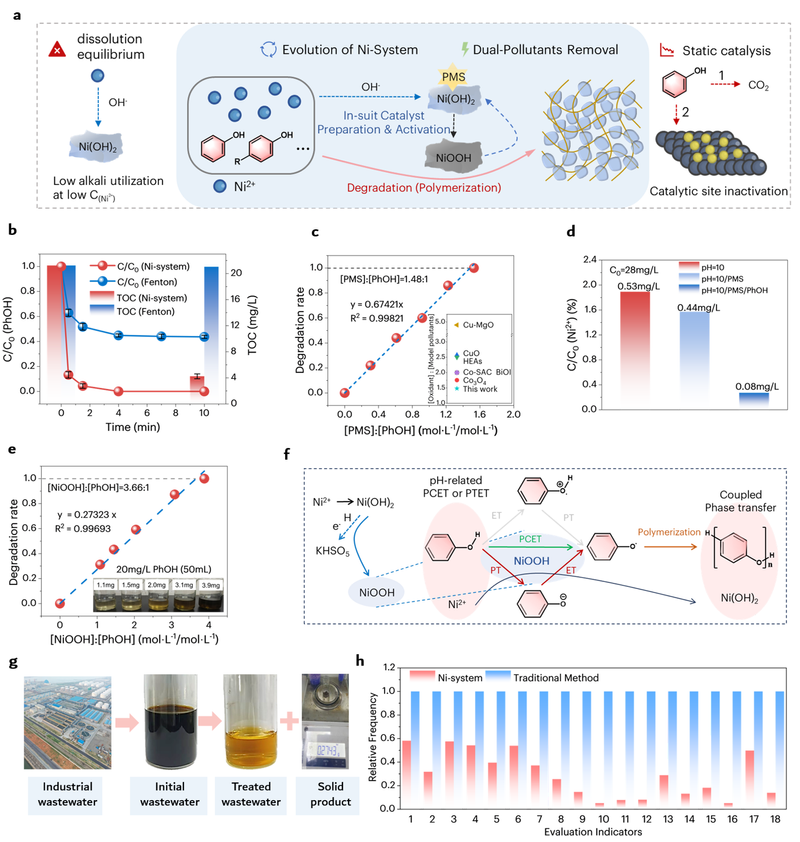
This work pioneered a phase-transition self-catalysis paradigm that eliminates metal ions and phenolic pollutants synchronously without external catalyst addition. Distinct from conventional treatment systems, the innovative design integrates three processes, namely in-situ catalyst generation from pollutants, deep capture of metal ions, and solid-state carbonization conversion of phenolic pollutants into a single self-evolving purification system.
In the Ni²⁺-phenol dual-pollutant system, the strategy greatly boosted removal efficiency of both pollutants under low oxidant consumption, outperforming traditional stepwise treatment routes. The team systematically characterized intermediate and final products formed during phase transition and clarified the synergistic mechanism accelerating pollutant degradation. Based on multiple characterization tests and density functional theory (DFT) calculations, researchers illustrated the unique self-catalytic reaction pathway involving Ni(OH)₂, NiOOH and phenol, which covers proton-coupled electron transfer (PCET) and proton transfer (PT) processes.
Furthermore, the group verified the operational stability of this technology in real industrial wastewater treatment, explored the post-treatment process and conceptual models, and demonstrated promising practical application potential via economic benefit assessment and full life cycle assessment (LCA). The research breaks the inherent mindset of treating pollutants as mere disposal targets, and transforms contaminants into functional water treatment catalysts, delivering an innovative and scalable technical route for sustainable aquatic remediation.
Associate Professor Yayun Zhang is the first author of this paper. Professor Mingyang Xing and Professor Chengcheng Tian are the corresponding authors. This research was completed under the guidance of Professor Jinlong Zhang, Fellow of the Academia Europaea.
The study received support from multiple platforms and programs, including the State Key Laboratory of Green Chemical Engineering and Industrial Catalysis, the Feringa Nobel Prize Scientists Joint Research Center, the Frontiers Science Center for Materials Biology and Dynamic Chemistry under the Ministry of Education, the National Natural Science Fund for Distinguished Young Scholars, and the Science Fund for Innovative Research Groups of the National Natural Science Foundation of China.