
New Progress in Cocatalyst-Semiconductor Heterojunction OER Mechanisms from ECUST Reported in Energy & Environmental Science
Recently, the research group led by Professor Haifeng Wang from the Institute of Industrial Catalysis/Center for Computational Chemistry, School of Chemistry and Molecular Engineering, ECUST, published a theoretical study titled “Disentangling the Activity-Charge Coupling in Cocatalyst-Semiconductor Heterojunctions for Optimized Oxygen Evolution” in Energy & Environmental Science, reporting the latest advances in the mechanistic understanding of the photocatalytic oxygen evolution reaction (OER) over cocatalyst-semiconductor heterojunctions.
Solar-driven water splitting for hydrogen production is a key pathway toward green energy conversion. Among the half-reactions, OER involves multi-electron, multi-proton transfer processes with inherently sluggish kinetics, constituting one of the core bottlenecks limiting overall photocatalytic efficiency. Loading cocatalysts on semiconductor surfaces has long been regarded as an effective strategy to enhance OER performance. It is generally believed that cocatalysts serve a dual role: providing reactive sites to lower surface reaction barriers and modulating interfacial charge distribution to promote photogenerated hole accumulation at reaction sites.
However, in practical cocatalyst-semiconductor heterojunction systems, these two effects are highly coupled, making it difficult to disentangle their individual contributions. This has left cocatalyst screening and performance optimization without clear quantitative theoretical guidance.
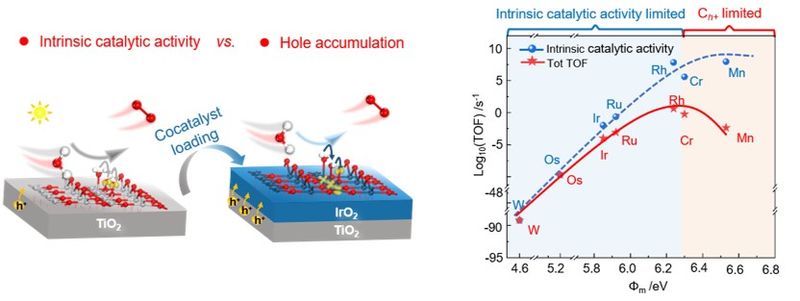
To address this challenge, the team employed a prototypical IrO2/TiO2 cocatalyst-semiconductor heterojunction as a model system and combined ab initio molecular dynamics with first-principles microkinetic simulations to systematically investigate the photocatalytic OER process at the solid-liquid interface. The study established an “intrinsic activity-charge accumulation” decoupling framework, quantitatively separating the cocatalyst’s direct modulation of reaction activity from its induced surface hole accumulation effect, thereby enabling mechanistic analysis of OER enhancement on catalyst surfaces.
This work elucidates the microscopic mechanism by which “activity-carrier” coupling governs photocatalytic OER over cocatalys-semiconductor heterojunctions from a theoretical standpoint, moving beyond the conventional oversimplified attribution of cocatalyst effects to merely “enhancing intrinsic activity” and “increasing hole concentration”. The findings not only deepen the understanding of interfacial reaction processes in photocatalytic water oxidation but also provide a generalizable design paradigm for efficient heterojunction catalytic materials targeting solar fuel production.
Ying Liu, a postdoctoral researcher and Min Zhou, the associate research fellow from the School of Chemistry and Molecular Engineering, ECUST, are the co-first authors of the paper. Professor Haifeng Wang is the corresponding author. This work was supported by the State Key Laboratory of Green Chemical Engineering and Industrial Catalysis, the National Key R&D Program of China, and the National Science Fund for Distinguished Young Scholars of China.