
New Progress in Fundamental Kinetic Studies of OX-ZEO Coupling Catalysis from ECUST Published in Nature Catalysis
Recently, the research group led by Professor Haifeng Wang from the Institute of Industrial Catalysis and the Centre for Computational Chemistry, School of Chemistry and Molecular Engineering at ECUST, published a research article entitled “The kinetic basis of bifunctional OX-ZEO catalysts for syngas conversion to light olefins” in Nature Catalysis. The study has reported the group’s latest progress in the fundamental kinetics of bifunctional oxide-zeolite (OX-ZEO) catalysts for syngas conversion to light olefins.
OX-ZEO catalytic systems have attracted extensive attention because of their exceptional selectivity for the direct conversion of syngas into light olefins. In these systems, syngas is first converted into ketene (CH₂CO) intermediates on the metal oxide component, which subsequently diffuse into the zeolite channels and are further transformed into light olefins.
This coupled two-stage process overcomes the limitations imposed by the Anderson-Schulz-Flory (ASF) distribution on product selectivity in conventional Fischer-Tropsch synthesis. However, the synergistic catalytic mechanism between the metal oxide and zeolite components has remained poorly understood, significantly hindering the rational optimization and design of OX-ZEO catalysts.
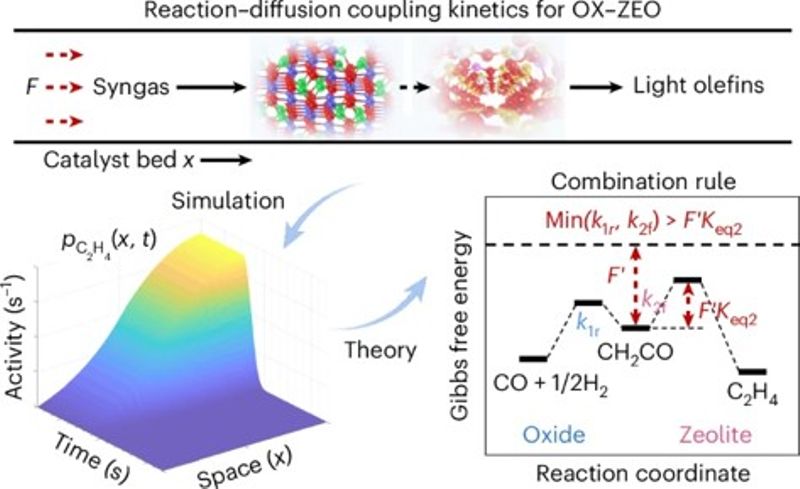
To address this critical scientific challenge, the research team employed a representative ZnCrOx/mordenite (MOR) catalyst as a model system. Through density functional theory (DFT) calculations, they obtained the complete energetics data for the reaction network and innovatively established a diffusion-bridged, two-component microkinetic model. For the first time, this model quantitatively coupled and analyzed the syngas activation process on the metal oxide surface, intermediate mass transport, and CH₂CO conversion within zeolite channels at the kinetic level. Combined with a plug-flow reactor (PFR) model, it enabled a comprehensive spatiotemporal kinetic description of the OX-ZEO catalytic system.
The researchers found that, in the absence of the zeolite component, methane (CH₄) was the dominant product formed on ZnCrOx. After introducing MOR, the selectivity toward light olefins increased dramatically to 92%, while methane accounted for only 8% of the products.
Spatiotemporal kinetic analysis revealed that the zeolite provides an efficient conversion pathway for the key intermediate CH₂CO, overcoming thermodynamic limitations associated with CH₂CO formation on the oxide surface. As a result, carbon-containing species preferentially couple with CO to form CH₂CO rather than undergo hydrogenation to CH₄ in the presence of MOR. This finding quantitatively elucidates the microscopic mechanism underlying the zeolite “pulling effect” that governs reaction selectivity.
The study further revealed an inverted U-shaped relationship between the spatial coupling distance of the two components and product selectivity. When the distance exceeded 5.0 mm, diffusion became the rate-controlling step and CH₄ formation predominated. As the distance decreased to approximately 0.20 mm, catalytic performance reached its optimum, in excellent agreement with experimental observations.
However, when the distance was further reduced to the scale of chemical bonding, Zn species migrated into the zeolite channels and formed [ZnOH]⁺ active sites, which promoted the hydrogenation of ethylene (C₂H₄) to ethane (C₂H₆), thereby decreasing light olefin selectivity. This finding not only explains the counterintuitive phenomenon that excessively close contact between catalyst components can be detrimental, but also provides a quantitative basis for optimizing catalyst particle mixing strategies.
Based on these mechanistic insights, the team further established a generalized reaction-diffusion coupling kinetic model for OX-ZEO systems and derived universal catalyst optimization principles together with quantitative design equations. These included the optimal space velocity equation, F’opt=(k₁r×k₂r)¹/², and the optimal component-matching criterion, min(k₁r, k₂f)>F’Keq₂.
These results provided a theoretical foundation for the development of high-performance OX-ZEO catalysts. Model predictions showed excellent agreement with experimental data, and several promising new component combination schemes are proposed.The findings offered broad insights into the synergistic mechanisms of OX-ZEO catalytic systems and may serve as a useful framework for understanding other tandem catalytic processes.
Zhuangzhuang Lai, a postdoctoral fellow from the School of Chemistry and Molecular Engineering at ECUST, is the first author of the paper. Associate Professor Jianfu Chen and Professor Haifeng Wang are the corresponding authors. This work was supported by the State Key Laboratory of Green Chemical Engineering and Industrial Catalysis, the National Key Research and Development Program of China, the National Natural Science Foundation of China, and the Fundamental Research Funds for the Central Universities.