
New Progress in Industrial Microbial Growth Regulation and High-Performance Cell Factory Design from ECUST Published in Nature Communications
Recently, a research team led by Associate Professor Guan Wang from the School of Biotechnology, ECUST, achieved progress in industrial microbial growth regulation and high-performance cell factory design. The study, entitled “Energy-translation Coupling Limits Anaerobic Yeast Growth,” was published in Nature Communications.
The research team established strictly anaerobic continuous culture systems under carbon, nitrogen, and phosphorus limitation to systematically investigate the mechanisms constraining the growth of Saccharomyces cerevisiae under different nutrient-limited conditions.
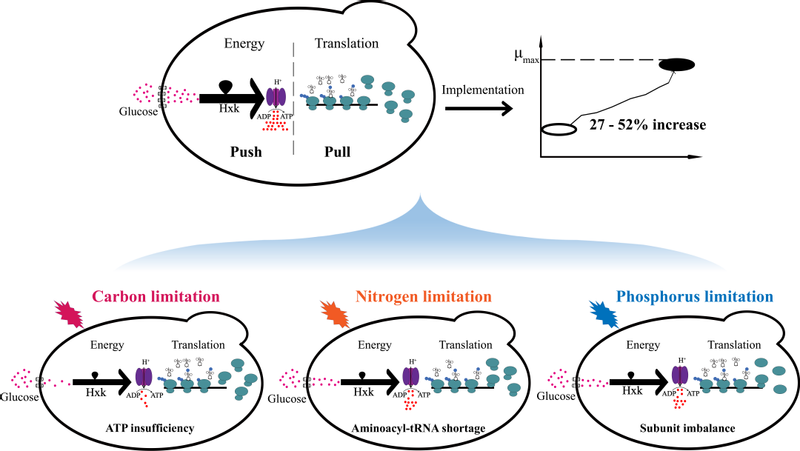
The study found that although yeast exhibited a conserved maximum glucose uptake rate of approximately 14 mmol/gDW/h across all three nutrient-limited conditions, the factors limiting growth differed. Further analyses revealed that energy metabolism and protein translation formed a tightly coupled regulatory network that jointly determined the upper limit of anaerobic growth in yeast.
Based on these findings, the researchers proposed and validated a “Push–Pull” strategy for metabolic engineering. The “Push” component enhanced cellular energy supply through over-expression of VMA3, which encoded a subunit of the vacuolar ATPase, while the “Pull” component improved protein translation capacity through over-expression of WRS1, encoding tryptophanyl-tRNA synthetase.
This strategy overcame the intrinsic growth constraints of yeast, increasing the maximum anaerobic growth rate by 27.2%, 47.5%, and 52.5% under carbon, nitrogen, and phosphorus limited conditions, respectively, while improving ethanol production performance.
These findings provided new insights and engineering strategies for the rational design of high-performance industrial strains, with broad implications for bio-manufacturing and industrial fermentation.
Yongbo Wang, a PhD candidate, and Yu Huang, a master’s student from the School of Biotechnology at ECUST, are co-first authors of the paper. Associate Professor Guan Wang serves as the corresponding author. The research was conducted under the guidance of Professor Yingping Zhuang.
The work was supported by the National Key Research and Development Program of China, the National Natural Science Foundation of China, the Natural Science Foundation of Shanghai, the Taishan Scholars Young Expert Program of Shandong Province, the Explorers Program of Shanghai (Basic Research Funding), and the Jiangsu Provincial Major Science and Technology Special Project.