
Overseas Promotion of “Coconut Soap Guardian” in Sri Lanka: ECUST Pioneers Innovative Green Control Approaches for Tea Pests
Recently, the “Coconut Source Biology” Team, guided by Professor Xusheng Shao from ECUST’s school of Pharmacy, has independently developed a botanical green plant protection product named Coconut Soap Guardian.
The product has attracted its first overseas cooperation opportunity from Sri Lanka, helping the tea industry address pest and disease challenges and promote the green development of tea cultivation. Since its overseas launch, the research achievement has been reported by more than ten media including Guangming Daily, China Youth Daily and Shanghai Observer, gaining wide attention from the industry.
For a long time, pest infestation and residue of traditional pesticides have restricted the high-quality green development of the tea industry worldwide. Based on the concept of ecological plant protection and supported by the university’s scientific research platforms, the team developed Coconut Soap Guardian with coconut soap diamide as its core active ingredient.
Derived from natural coconut trees, the product has a unique insecticidal mechanism. It can block the spiracles of pests and decompose the waxy protective layer on pest body surfaces to kill pests. It is safe for silkworms and other non-target organisms, and can increase soil organic matter after degradation, realizing three major functions: pest control, tea protection and soil improvement.
The product has been widely applied in tea plantations in Xinyang of Henan Province, Jinshan and Qingpu Districts of Shanghai. Compared with traditional pesticides, it improves the prevention and control efficiency of major tea pests by 10% to 20%, and boosts tea garden yield by 20% to 30%, winning recognition from local tea enterprises.
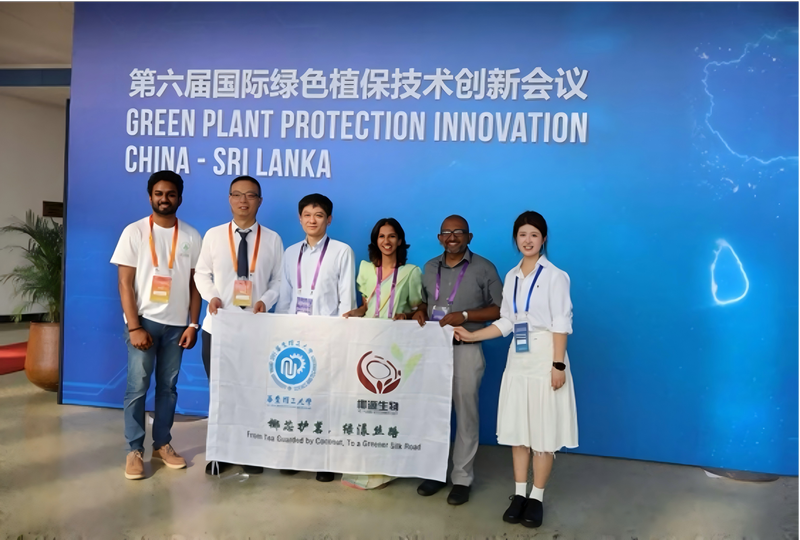
At the 6th International Conference on Green Plant Protection Technology Innovation held in Colombo, Sri Lanka, the team exhibited Coconut Soap Guardian and conducted in-depth technical exchanges with the Sri Lanka Tea Board and the University of Peradeniya. In view of the worsening pest problems in Ceylon black tea producing areas, the two sides reached a cooperation intention. The team will visit Sri Lanka soon to develop tailor-made green pest-control solutions for local tea plantations.
Moving forward, the team will comprehensively promote the overseas application of this technology. It will optimize the product formula to adapt to the ecological environment of overseas tea plantations, build long-term cooperation with Sri Lanka, and provide standardized pesticide application technologies and professional agricultural technical training. Meanwhile, the team will launch an international tea science and technology exchange program, promoting mature green prevention and control technologies to tea-producing countries along the Belt and Road such as Vietnam and Kenya, thereby supporting the development of the global ecological tea industry.