
New Progress in Single-Particle Electrocatalytic Characterization from ECUST Published in Journal of the American Chemical Society and Nano Letters
Conventional electrochemical characterization is typically based on the ensemble-averaged response of nanomaterials, which can obscure structural differences, catalytic activity, and structure-activity relationships among individual nanoparticles. Single-particle electrochemical characterization helps address this limitation by capturing individual behaviors during electrochemical reactions, providing a means to investigate the intrinsic properties and structure-activity relationships of nanocatalysts.
Recently, Professor Wei Ma’s team from the School of Chemistry and Molecular Engineering at ECUST made new progress in single-particle electrochemical characterization, with related findings published in Journal of the American Chemical Society and Nano Letters.
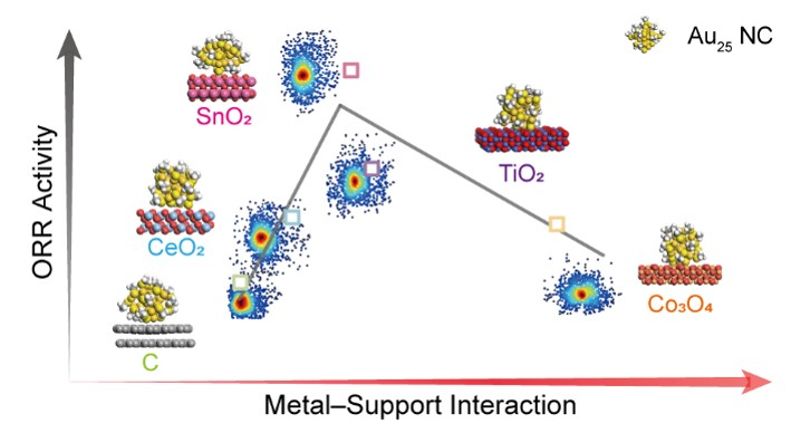
Metal-support interactions (MSIs) play an important role in regulating the activity and stability of heterogeneous catalysts. However, conventional characterization methods mainly provide ex situ, ensemble-averaged information, making it difficult to quantify MSI-activity relationships during reactions.
The team used single-entity collision electrochemistry (SECE) to investigate the oxygen reduction reaction (ORR) of individual Au25 nanoclusters (NCs) on different metal oxide supports. By correlating collision current amplitude with ORR activity and event duration with MSI strength, the study established a single-entity correlation between MSIs and catalytic activity.
The results revealed a volcano-type relationship, with SnO2 providing an intermediate MSI strength that balanced interfacial charge transfer, intermediate adsorption, and catalyst anchoring. DFT calculations further supported this relationship. The findings provided a method for probing MSIs and catalytic activity at the single-entity level.
The results were published in Journal of the American Chemical Society under the title “Activity-Stability Volcano in Supported Electrocatalysis: Single Entity Correlation of Au25 Nanoclusters Between Oxygen Reduction Activity and Metal-Support Interaction.” PhD candidates Yixiao Wang and Cheng Chen are co-first authors, and Professor Wei Ma and Associate Professor Jianfu Chen are co-corresponding authors.
The team developed an anodic-cathodic single-nanoparticle collision electrochemical strategy to correlate electrochemical dealloying with ORR activity for the same Au@Ag nanoparticle. By analyzing paired anodic and cathodic current transients, the method established a one-to-one correlation among dealloying extent, composition, and catalytic activity at the single-particle level. Using a nitrogen-functionalized carbon ultramicroelectrode to expand the accessible dealloying window, the study identified an optimal Ag/Au atomic ratio of 2.5:1 for ORR activity. The results were published in Nano Letters under the title “In Situ Correlation of Dealloying and Oxygen Reduction Activity in Single Au@Ag Nanoparticles.” Master’s student Ying Zhou is the first author, and Professor Wei Ma is the corresponding author.
The work was supported by the Key Laboratory for Advanced Materials of the Ministry of Education, the Feringa Nobel Prize Scientist Joint Research Center, the National Natural Science Foundation of China, and the Shanghai Science and Technology Major Project.