
New Progress in CO₂ Hydrogenation Catalyst Research from ECUST Published in Nature Communications
Recently, the Catalysis and Reaction Engineering team of Professor Xuezhi Duan and Research Professor Yueqiang Cao at ECUST achieved new progress in the precise regulation of CO₂ hydrogenation reaction pathways.
Addressing the challenge that non-precious nickel catalysts tend to undergo methanation and struggle to selectively produce carbon monoxide, the research team switched the CO₂ hydrogenation pathway from methanation to reverse water-gas shift (RWGS) by tuning the Ni-CO electron back-donation. The findings, titled “Tuning Electron Back-Donation to Switch Reaction Pathway in CO₂ Hydrogenation”, have been published in Nature Communications.
Catalytic CO₂ hydrogenation is an important pathway for carbon resource recycling and green fuel synthesis. Carbon monoxide produced via the reverse water-gas shift reaction can be combined with hydrogen to form syngas, which can be further converted into liquid fuels and high-value-added oxygen-containing chemicals.
Nickel offers advantages of abundant reserves, low cost, and high hydrogenation activity, but its surface typically exhibits strong electron back-donation to adsorbed CO intermediates (CO*), stabilizing CO* and promoting its further deep hydrogenation to methane, thereby reducing CO yield and consuming valuable hydrogen.
Therefore, enabling timely CO* desorption while maintaining CO₂ activation capability is the key scientific issue for shifting nickel-based catalysts from methanation to highly selective RWGS.
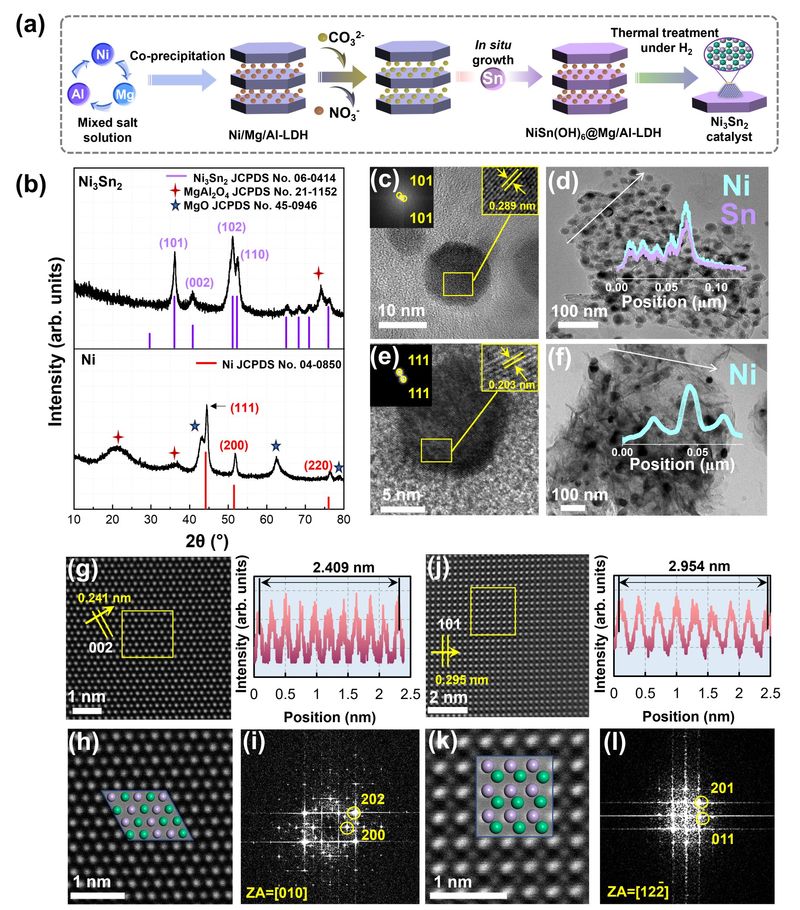
To address this challenge, the research team constructed an atomically ordered Ni₃Sn₂ intermetallic catalyst. Aberration‑corrected scanning transmission electron microscopy and X‑ray absorption spectroscopy results revealed that Sn atoms interrupt the continuous Ni-Ni ensemble sites, forming Ni sites with well‑defined local structures.
Further spectroscopic characterization and theoretical calculations revealed that significant d-p orbital hybridization between Ni and Sn narrows the Ni 3d band and shifts it to lower energy levels, reducing the Ni 3d density of states near the Fermi level. This weakens the electron back-donation from Ni to the CO 2π* antibonding orbitals and reduces the Ni-CO bonding strength.
Consequently, the CO* generated during the reaction can rapidly desorb before further hydrogenation, switching the reaction pathway from methanation to selective CO production.
Performance evaluation showed that the Ni₃Sn₂ catalyst maintains near 100% CO selectivity across the 200-400 °C range. At 400 °C, the CO₂ conversion reached 34.4% with 99.7% CO selectivity, approaching the thermodynamic equilibrium limit of the RWGS reaction. After 300 hours of continuous operation, the catalyst retained over 95% of its initial CO₂ conversion, with CO selectivity maintained at 100%.
In contrast, under the same temperature, the monometallic Ni catalyst achieved 52.5% CO₂ conversion, but 93.2% of the converted CO₂ was converted to methane, further highlighting the reaction pathway regulation effect of ordered Ni₃Sn₂. Mechanistic studies indicate that the key to product selectivity lies in the fate of the branching intermediate CO* after its formation: on the Ni₃Sn₂ surface, CO* exhibits low coverage, short residence time, and rapid desorption, effectively suppressing the subsequent deep hydrogenation pathway to methane.
The research team further prepared and evaluated Ni₃Ga and Ni₂In intermetallic compounds. Both catalysts achieved over 90% CO selectivity at 400 °C, verifying the generality of this regulation strategy.
Zhongnian Huang and Jundi Wang, Ph.D. candidates from the School of Chemical Engineering, and Xiaohu Ge, a Research Professor, are the co-first authors of this paper. The corresponding authors are Professor Xuezhi Duan, Research Professor Yueqiang Cao from ECUST, and Associate Professor Yong Yang from ShanghaiTech University. The research was conducted under the guidance of Academician Weikang Yuan, Academician De Chen, and Professor Xinggui Zhou.
The study was supported by the National Key Research and Development Program of China, the National Natural Science Foundation of China, Fundamental and Interdisciplinary Disciplines Breakthrough Plan of the Ministry of Education of China, and the Shanghai Municipal Education Commission and the Science and Technology Commission of Shanghai Municipality.