
New Progress in Acidic CO₂ Electroreduction of Zero-Gap PEM Electrolyzer from ECUST Published in Advanced Materials
Recently, a study on acidic CO₂ electroreduction by the Clean Energy Materials and Devices Group at the School of Materials Science and Engineering, ECUST, was published in Advanced Materials, titled “Mercaptoimidazole-Engineered Microenvironment Enables Durable CO₂ Electroreduction in a Zero-Gap PEM Electrolyzer.”
The work anchored a mercaptoimidazole ligand on lead-based catalysts to build a molecular interface with proton-shielding and local-environment modulation functions, achieving high-selectivity and long-lived CO₂ electroreduction to formate in a zero-gap proton exchange membrane (PEM) electrolyzer.
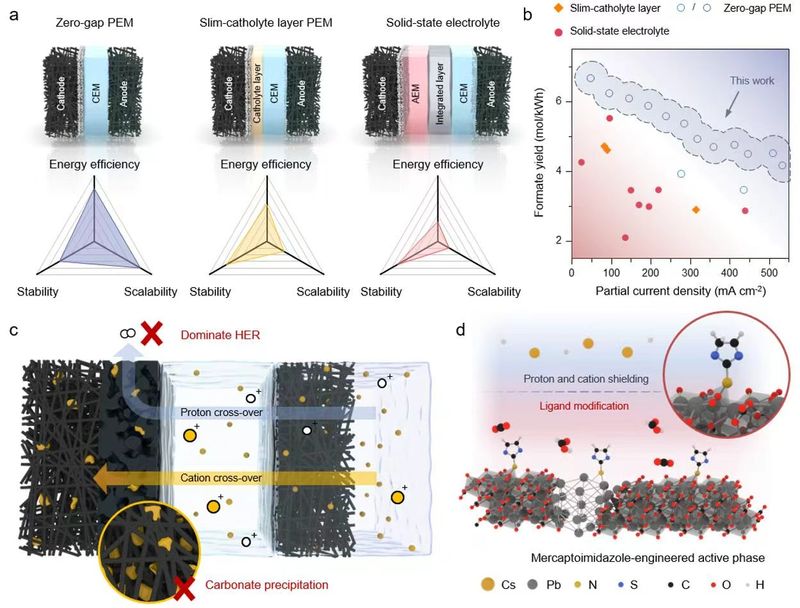
Electrochemical CO₂ reduction converted CO₂ into fuels and chemicals for cyclic carbon utilization. Conventional neutral or alkaline systems suffered from carbonate formation that clogged electrodes. Acidic electrolysis avoided carbonate generation, yet heavy proton migration accelerated the hydrogen evolution side reaction and reduced product selectivity. For compact zero-gap PEM electrolyzers, simultaneous suppression of hydrogen evolution and salt precipitation remained a major bottleneck.
The team proposed a molecular ligand strategy to tune catalytic microenvironments. Mercaptoimidazole ligands anchored on lead-based precursors formed a stable ligand shell. This shell acted as a molecular barrier, decoupling the catalyst’s local environment from strongly acidic bulk electrolyte to curb hydrogen evolution and salt precipitation. Operando spectroscopy and theoretical studies confirmed the ligand shell creates a local alkaline microenvironment and modulated lead sites to lower reaction barriers for formate intermediates.
The zero-gap PEM electrolyzer achieved a peak formate Faradaic efficiency of 95.8%, retaining over 90% selectivity across 50-600 mA cm⁻². It maintained high selectivity under pH 1.0 and cation-starved (0.001 M) conditions, and ran stably for more than 300 h at 100 mA cm⁻². The strategy was also applicable to silver-based catalysts. This work offered a new material design route for acidic CO₂ electrolysis devices.
This research was completed by Ph.D. candidate Jiachen Wu under the guidance of Professor Huagui Yang and Associate Professor Pengfei Liu. The study was supported by the National Natural Science Foundation of China and the Shanghai Basic Research Special Zone Program.