
ECUST Held Forum on Environmental Discipline Construction and Development
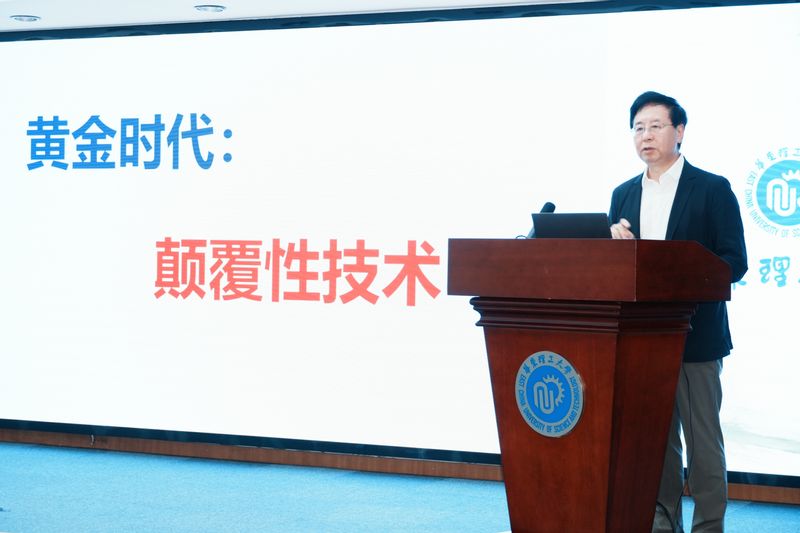
Recently, the Forum on Environmental Discipline Construction and Development was held at the Xuhui Campus, ECUST. Professor Jiuhui Qu (Academician of the Chinese Academy of Engineering and Research Center for Eco-Environmental Sciences, Chinese Academy of Sciences) was invited to deliver a keynote report titled “Environmental Science: A Golden Age from Theory to Technology.”
ECUST President Fuzhen Xuan attended the forum and chaired the keynote session. Also present were Professor Hualin Wang (Academician of the Chinese Academy of Engineering, School of Resources and Environmental Engineering, ECUST), Professor Min Yang (Chinese Academy of Sciences Research Center for Eco-Environmental Sciences, distinguished ECUST alumnus), Professor Guangli Xiu (Secretary of the CPC Committee of the School of Resources and Environmental Engineering, ECUST), and Professor Guangsuo Yu (Dean of the School of Energy, ECUST).
Xuan welcomed Academician Qu and noted that China was advancing the Beautiful China Initiative, with strategic needs driving the environmental discipline from breakthroughs in basic theory toward engineering applications and deeper integration of industry, academia, and research.
ECUST had aligned itself with national ecological and environmental strategies, addressing industrial challenges such as pollution control, low-carbon energy conversion, and solid waste utilization, and had produced core technologies that had advanced from the laboratory to industrial application. He hoped Academician Qu would offer guidance for ECUST’s environmental discipline. Wang introduced Qu’s academic achievements and contributions.
From a macro perspective, Qu interpreted the core ideas of Science: The New Golden Age. He outlined an evolutionary path that began with the first-principles theory of environmental balance, progressed through the establishment of an axiom system for environmental science, and ultimately led to disruptive technological innovation. He also emphasized the need for cross-disciplinary integration from theory and methodology to practical applications.
During the exchange session, faculty and students discussed environmental infrastructure for strategic industries, disruptive technology R&D, and research translation.
Xiu then chaired the forum’s discussion session. Qian Sui, Vice Dean of the School of Resources and Environmental Engineering, presented a report titled “Environmental Discipline Development under New Circumstances: Dilemmas and Opportunities.” Participants discussed the current state, challenges, and opportunities of the discipline.
Qu suggested that ECUST build on its strengths in chemistry and chemical engineering and its engineering characteristics, clarify the innovation paradigm and goals of the environmental discipline, focus on addressing key technological challenges, and contribute to ecological civilization and green low-carbon transformation.
The forum helped build consensus and clarify priorities for future development, providing support for the high-quality development of ECUST’s environmental discipline.