 09 Nov 2026

Recently, researchers led by Professor Jianguo Yu and Research Professor Yuqing Lin from the National Engineering Research Center for Comprehensive Utilization of Salt Lake Resources at ECUST made significant progress in high-performance ion-selective separation membranes. The findings, titled “Hydration channel engineering in Tröger’s base-POP membranes for mono/multivalent cation and anion discrimination,” were published in Science Advances.
Conventional ion-exchange membranes struggle to balance ion transport efficiency and selectivity and are often limited to separating specific cationic or anionic systems. To address these challenges, the team proposed a broad-spectrum ion-sieving strategy based on hydration channel engineering.
They constucted Tröger’s base-derived porous organic polymer (POP) membranes featuring rigid covalently crosslinked networks. The team precisely controlled subnanometer ion transport channels to suppress membrane swelling while enabling rapid transport of monovalent ions and efficient rejection of multivalent ions.
Experimental characterization and molecular simulations revealed how steric confinement, ion dehydration energy barriers, and electrostatic interactions jointly regulate selective ion migration. The membranes achieved selective separation of monovalent and multivalent ions across both cationic and anionic systems, with excellent ion transport performance and operational stability.
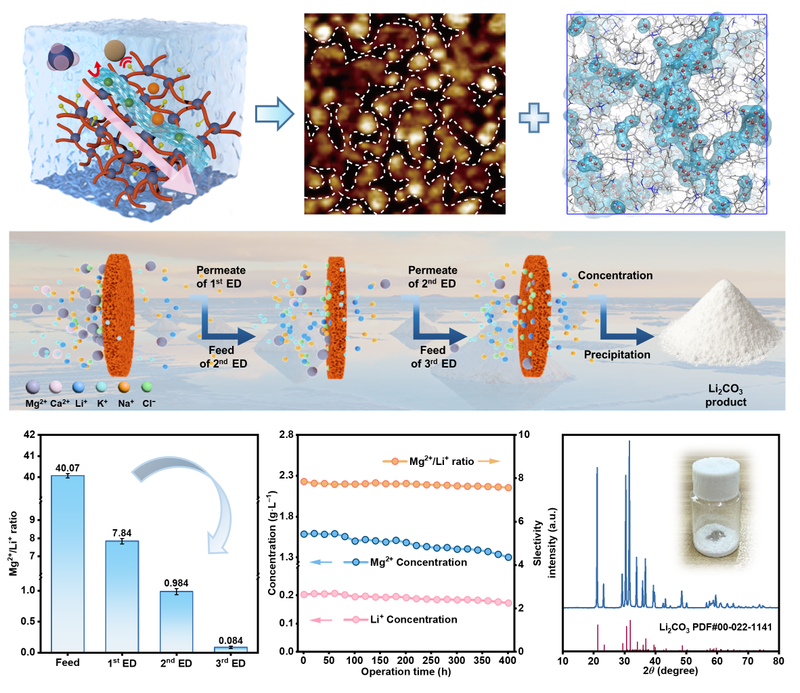
The team further demonstrated the potential of these membranes for resource recovery from complex brines, including lithium extraction from salt lake brines and purification of simulated seawater. For salt lake brines with high magnesium-to-lithium ratios, they developed a three-stage electrodialysis process for lithium enrichment.
By progressively suppressing Mg²⁺ transport, the process reduced the Mg²⁺/Li⁺ ratio to approximately 1/500 of its initial value, without first removing magnesium and calcium by precipitation. Subsequent concentration and lithium precipitation yielded lithium carbonate with a purity of 99.5%.
The membranes also selectively removed multivalent impurity ions from simulated seawater and enabled high-purity sodium chloride enrichment, demonstrating their applicability to different ionic systems. These findings offer new approaches to membrane design and technologies for efficient separation and recovery of critical resources from complex brines.
PhD candidate Haopan Sun and Research Assistant Professor Ning Gan from ECUST are co-first authors of the paper. Research Professor Yuqing Lin, Professor Hideto Matsuyama of Kobe University, Japan, and Professor Young Moo Lee of Hanyang University, South Korea, are co-corresponding authors. The research was supported by the International Science and Technology Cooperation Program of Shanghai and the China Postdoctoral Science Foundation.